
Checking Criminal History in Tangipahoa Parish
No unrestricted parish or Louisiana database contains every criminal record. Tangipahoa Parish readers should build the answer from the clerk's criminal index, the sheriff's report and booking systems, and an official state self-review when identity matching matters. Begin with a legal name, spelling variants, event date, and docket or booking number when known.
- Search the Tangipahoa Clerk criminal index for filed district cases. Use the free Amite terminal or Criminal Record eSearch.
- Match common names with filing dates, charges, divisions, and case numbers. Do not join records on a name alone.
- Check current custody through the TPSO LAVNS or TBS roster, then request the narrative from the arresting agency.
- Open the court file for minutes, pleadings, disposition, and sentence. A booking charge is not the final outcome.
- Order a certified disposition or use BCII Right to Review for your own Louisiana fingerprint-linked history when official proof is needed.
The Tangipahoa Parish Sheriff's Office gateway identifies the sheriff's public contacts and record services.
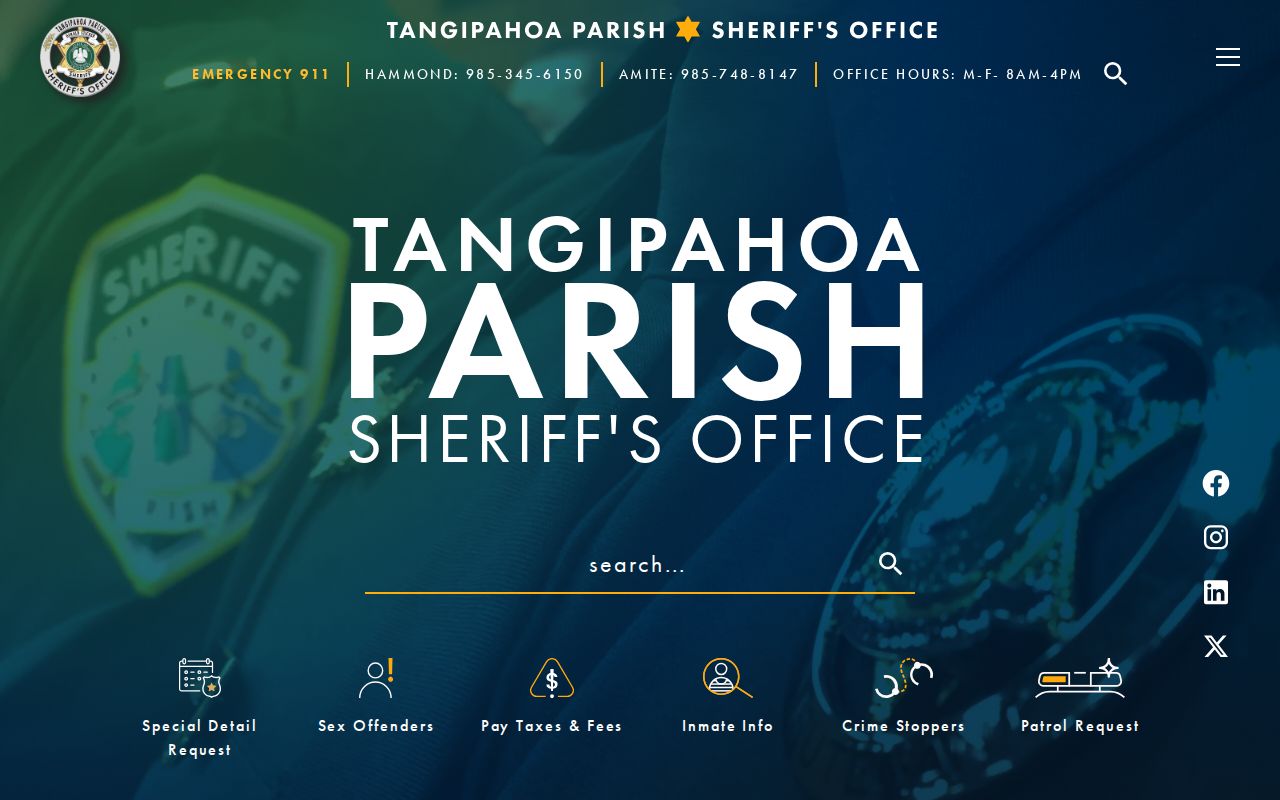
Use TPSO for sheriff-created reports and parish booking data, not for pleadings held by the clerk.
Three Tangipahoa Records, Three Answers
A booking entry proves custody and records the charges entered at intake. A court file shows how prosecutors and judges handled a case. A BCII history links qualifying Louisiana arrest cycles and reported dispositions to fingerprints. Calling all three a “criminal record” hides their different jobs.
Record flow: arresting agency › Tangipahoa Parish Jail › District Attorney › 21st JDC and Clerk › Louisiana State Police BCII.
| Source | Best Evidence Of | Does Not Prove |
|---|---|---|
| Booking entry | Custody, intake, and charges then | Guilt or final charge |
| Court file | Prosecution, events, and disposition | Every arrest elsewhere |
| BCII history | Fingerprint-linked Louisiana cycles | Full pleadings and narratives |
When the sources disagree, compare the final signed court entry with the booking record and your own Right to Review. Ask the office that owns the inaccurate segment to correct it.
A case number is the strongest bridge between docket entries and copies. A booking number helps TPSO isolate a custody event, while a police report number points to the narrative. Keep each identifier with its source and date. That small habit reduces false matches, especially when several people share a name or one event produces multiple charge descriptions.
Timing explains many apparent conflicts. Jail staff record the intake charge before the District Attorney completes screening. The prosecutor may later amend, decline, or dismiss a charge. The clerk then records the court result, and the disposition must still reach BCII. A current roster screenshot taken early in that chain cannot answer what happened at the end. Save the case number, obtain the final minute or judgment, and use that document when asking an agency to update a later record.
Louisiana Official Background Checks
For self-review, Louisiana's authoritative route is the BCII Right to Review under R.S. 15:588. Louisiana State Police uses the Louisiana Applicant Processing System, or LAPS, for digital fingerprint enrollment. This is an identity-based certified record, not a free public name search. The live enrollment process supplies current site, identification, and payment instructions.
LSP states that a $5 technology fee applies to every background-check request. The base Right-to-Review and local fingerprint charges were not visible in the research source, so confirm the full amount during scheduling. TPSO advertises local fingerprinting, but its indexed material did not publish a complete fee or appointment schedule.
The BCII background-check and Right-to-Review page is the official starting point.
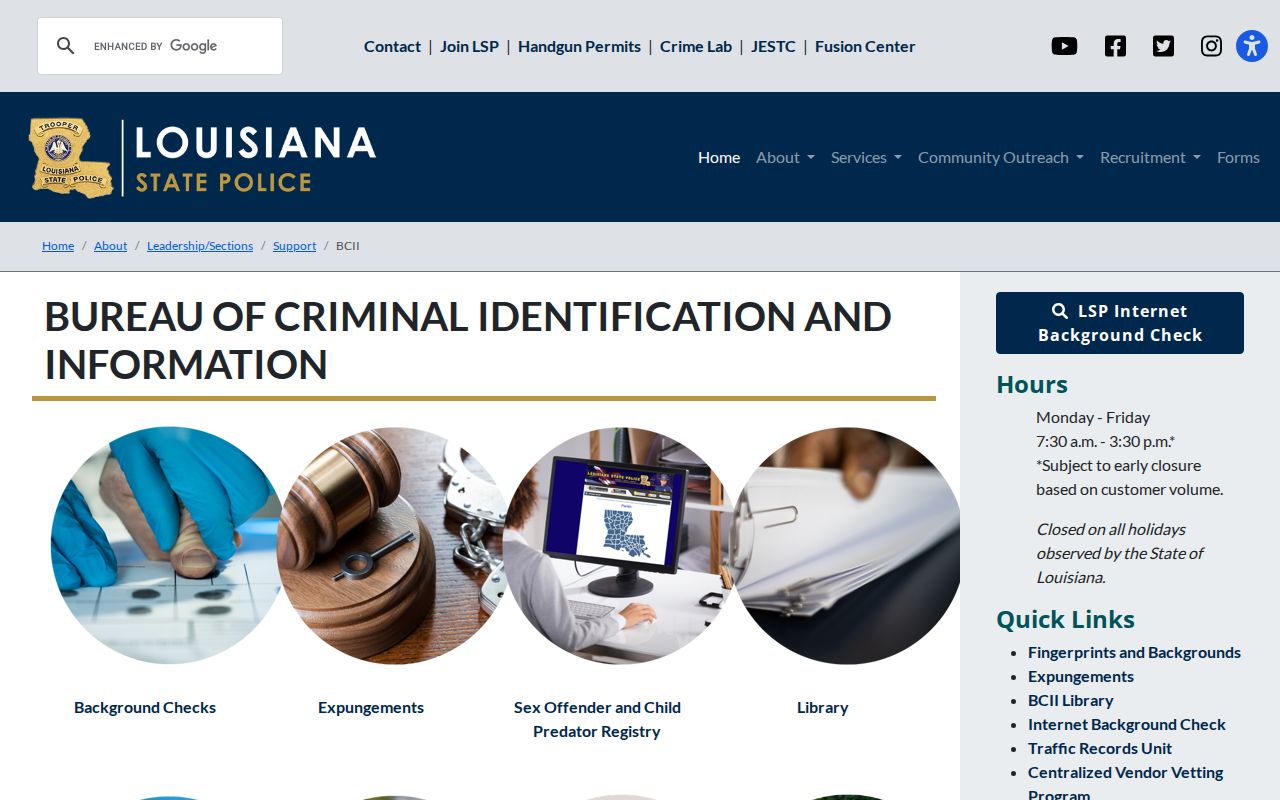
Use that fingerprint channel for your own statewide history and the parish clerk for full local case documents.
Tangipahoa Clerk Access Has Two Centers
The main Criminal Department is at 110 North Bay Street, Suite 100, Amite, LA 70422, 985-748-4146. It is open weekdays from 8:30 a.m. to 4:30 p.m. An individual may search the public criminal-index computer without charge. A written staff search costs $20 per name, and copies cost extra.
The Hammond branch at 318-A NW Railroad Avenue, Hammond, LA 70401, 985-549-1638, offers a southern-parish counter and closes from noon to 1:00 p.m. Judge-controlled matters and primary criminal-department work may still require Amite or the assigned division. The DA at 985-748-3234 supplies criminal court dates. Judges, not the clerk, control date changes and transcript orders.
The official clerk contact page shows the parish's two service locations.
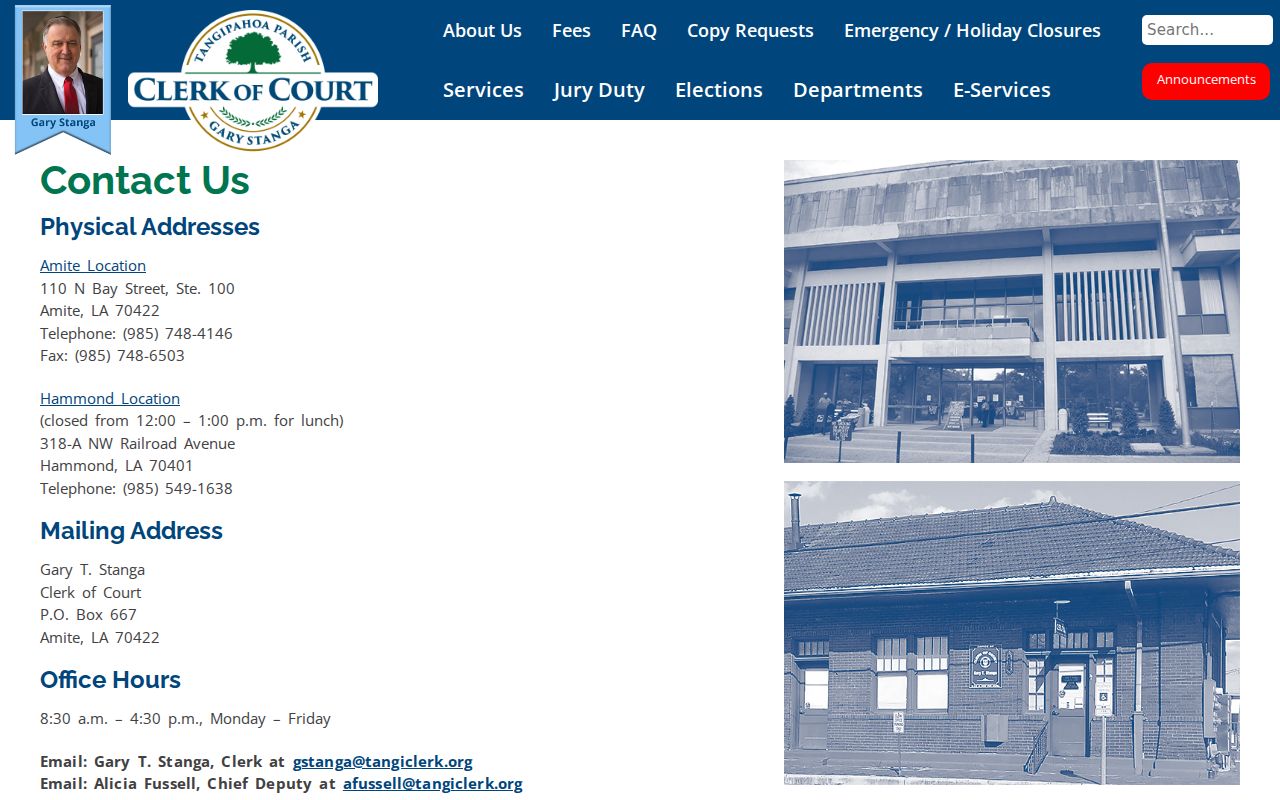
The two counters reflect the parish's long north-south geography, but they serve one Tangipahoa filing system.
Criminal Record Types
Tangipahoa Parish records are organized by event and custodian. Knowing the type prevents a request from going to an office that never held it.
- Incident and arrest report: the narrative created by TPSO or a municipal police department.
- Booking record: parish-jail intake, custody, charge, bond, and identifying data.
- Court case file: docket, pleadings, minutes, orders, disposition, sentence, and available images held by the clerk.
- BCII criminal history: fingerprint-linked arrest cycles and reported dispositions across Louisiana.
- Warrant, custody, and registry record: separate court, sheriff, corrections, or LSP products with distinct limits.
Police reports remain with the creating agency even when the subject is booked at the parish jail. A municipal case can stay in city court, while felonies move through the 21st JDC. Probation appears in a public judgment, but detailed supervision files are not an open dossier.
Warrants also require careful routing. No official public TPSO warrant-search interface was located. For your own possible warrant, contact the issuing court and TPSO through official numbers. A district bench warrant may appear as a capias in the clerk's docket. A municipal failure to appear belongs with the relevant city court. Do not approach a wanted person, and do not assume that a public web search covers sealed, state, or federal warrants.
Searching Tangipahoa Cases Back to 1901
Tangipahoa Criminal Record eSearch advertises criminal information back to 1901 and traffic data to 1974. Pre-1980s detail may be incomplete. Criminal document images generally begin in January 2007, while older material continues to be back-scanned. An index entry without an image therefore does not mean that no paper file exists.
Each online service requires its own login. Published subscriptions are $20 for 24 hours, $40 for 30 days, and $300 for one year. Printing costs $1 per page. The public landing page does not expose the actual name and case search fields before launch and login, so no unverified field labels should be treated as confirmed.
| Control | Type | Required | Notes |
|---|---|---|---|
| Create Login | Account action | Yes online | Separate login for the criminal service |
| Subscription | Choice | Yes online | 24-hour, 30-day, or one-year access |
| eSearch Launch | Button / link | Yes | Search form sits beyond the account boundary |
| Name / Case Fields | Not publicly visible | Unknown | Do not invent labels |
| Document Printing | Action | No | $1 per page |
Inside a Tangipahoa Parish Criminal Record
A rap sheet begins with identity and groups arrest cycles. A court file is arranged under a docket number and division. A jail record is arranged around a booking event. Read the field in the context of that record.
| Name & Identifiers | Legal name, aliases, date of birth, fingerprints, state number, and sometimes FBI number. |
|---|---|
| Arrest / Booking Data | Event date, arresting agency, intake details, alleged charges, and custody data. |
| Charges & Statutes | Offense description, statute, count, and filed classification. |
| Disposition | Dismissal, nolle prosequi, acquittal, plea, conviction, or other current outcome. |
| Sentence | Confinement, suspended time, probation, fines, costs, restitution, and concurrent or consecutive terms. |
| Custody / Supervision | Jail or prison status and public terms of court-ordered supervision, subject to access limits. |
- Disposition
- The final or current outcome of a charge.
- Nolle prosequi
- A prosecutor's decision not to proceed with a charge.
- Capias
- A court writ directing custody, often after failure to appear or comply.
- Expungement
- Louisiana's process making a qualifying record confidential without destroying it.
Tangipahoa Custody Is a Separate Search
TPSO provides two roster views. LAVNS supports an alphabetical list and VINELink custody notifications. TBS provides detailed “View” entries. Public list fields can include name, date of birth, race, gender, and arrest or booking date. Deeper detail may show a photograph, booking identifier, charges, bonds, and custody status.
A roster can lag a release or court disposition. It is not a conviction list. Someone removed from the current roster may still have a police report, historic booking, or filed case. Use Tangipahoa Parish Arrest Lookup for the full channel sequence. For a state prison placement, the Louisiana Imprisoned Person Locator is a different system.
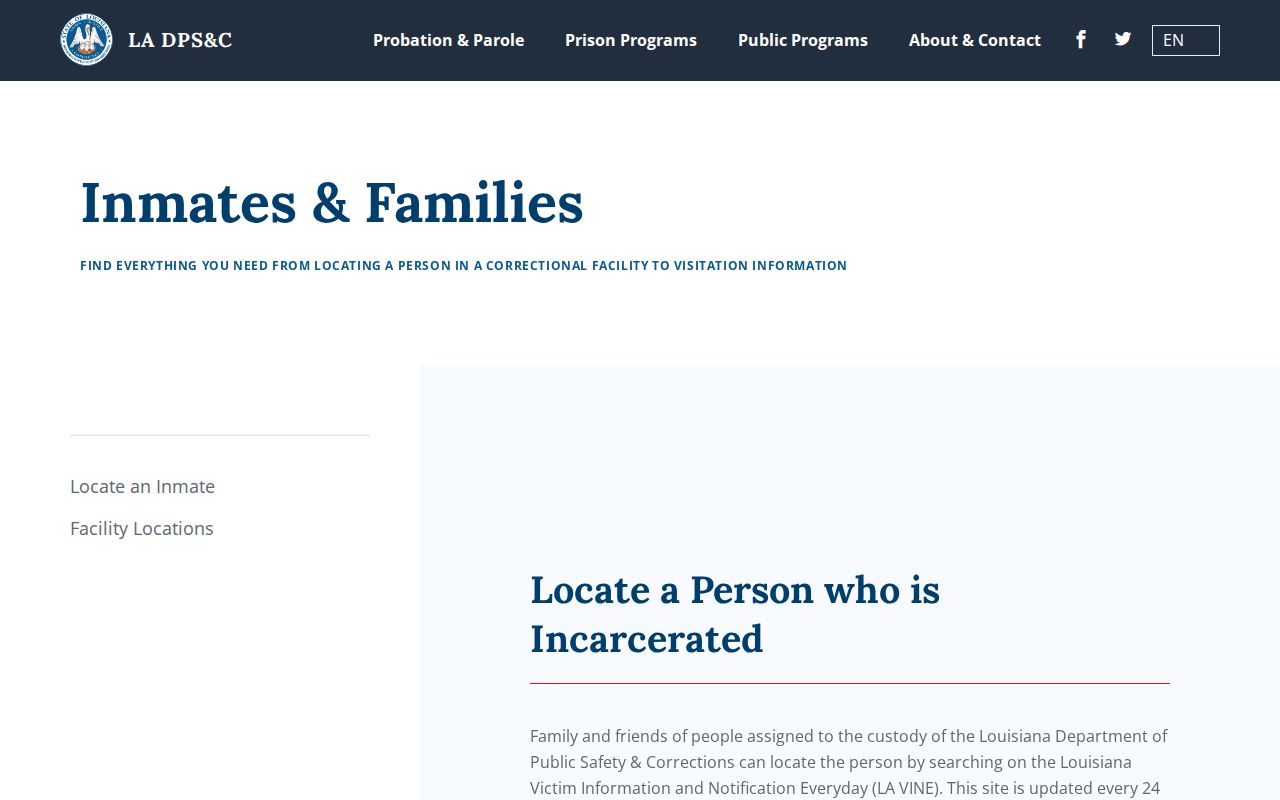
The state locator supplements the parish roster; it does not replace local booking or court records.
The parish jail is the main local incarceration site, but the reviewed official sources did not publish a dependable current address, rated capacity, visitation schedule, deposit rules, or release procedure. Confirm those operational details with TPSO. The sheriff also advertises a TPSO App for tips, alerts, services, and support, yet the research did not confirm store links or an app-only search feature. The public roster remains the documented web channel.
Public Access Laws in Louisiana
Access begins with the custodian. Ask the clerk for court files, TPSO or a city police department for its reports, and BCII for your own certified identity history. Public status does not prevent redaction of juvenile data, protected victim information, medical details, identifiers, or active investigative material.
Key Statutes:
Louisiana R.S. 44:1 et seq. sets the public-record and custodian framework.
Louisiana R.S. 15:587 controls BCII criminal-history dissemination.
Code of Criminal Procedure art. 971 removes qualifying expunged records from public access without destroying them.
Code of Criminal Procedure art. 973 makes expunged records confidential while preserving specified access.
A denial should state its legal basis. Narrowing a date range, report type, and event often makes a public-record request easier to process.
Tangipahoa Offices and Record Fees
TPSO's Criminal Records Division maintains arrest reports, attends court, and answers public requests for local background checks and reports. Call 985-345-6150 in Hammond or 985-748-8147 in Amite during weekday office hours, 8:00 a.m. to 4:00 p.m. TPSO did not publish a report fee, records email, identification rule, or promised turnaround in the reviewed sources.
Tangipahoa Clerk
110 N. Bay St., Ste. 100
Amite, LA 70422
985-748-4146
TPSO Records
Hammond and Amite service
985-345-6150
985-748-8147
| Product | Published Amount |
|---|---|
| Free clerk public-terminal search | $0 before copies |
| Clerk staff name search | $20 per name |
| Pleading copy | $1 per page |
| Criminal disposition | $10 per name |
| Minute extract | $10 |
| TPSO report or local check | Not located; request a quote |
Copy charges vary by product and channel. The clerk FAQ lists $3 in addition to copy costs for a conformed copy and $5 in addition for a certified copy, while the online service advertises $10 per certified document plus $1 per page. Obtain a quote before ordering because staff copies and online-certified products are not priced the same way. A criminal transcript is not an ordinary copy; it requires a written order signed by a judge.
Tangipahoa Cases in the 21st JDC
The Twenty-First Judicial District Court has original criminal jurisdiction across Tangipahoa, Livingston, and St. Helena parishes. Tangipahoa filings remain with the Tangipahoa Clerk. The district has nine elected divisions. Felonies proceed in district court, while city courts handle their statutory traffic, ordinance, and misdemeanor jurisdiction.
The 21st JDC homepage provides the official district and division gateway.
A filed court record may show arraignment, motions, settings, minute entries, plea, judgment, sentencing, capias, probation, and satisfaction. See Tangipahoa Parish Criminal Court Cases for file access and case stages.
Sealed, Expunged, and Restricted Records
Louisiana expungement makes qualifying material confidential; it does not destroy the record. Article 973 preserves access for specified criminal-justice purposes, the subject and counsel, certain statutory recipients, and a court upon good cause after a hearing. Juvenile records follow separate Children's Code rules.
Eligibility depends on the outcome, offense, timing, and statutory exclusions. Tangipahoa filings go to the clerk for the court holding the case. The clerk no longer supplies its own forms and points filers to statewide uniform materials or counsel. Arresting agencies, the DA, and BCII receive notice and may object.
The clerk states that a qualifying, unopposed Tangipahoa expungement commonly takes 60 to 120 days. The filing fee was not published in the reviewed FAQ. After an order, obtain certified copies and later check the public docket and your BCII Right to Review. A dismissal alone does not erase an arrest.
The uniform filing package calls for the court, caption, docket, personal contact information, arresting agency, arrest date, charges, disposition, legal basis, service recipients, and applicable supporting items. The exact record and offense control eligibility. Crimes of violence and sex or minor-victim offenses face statutory limits, with only narrow exceptions. Do not infer eligibility from a short charge label or promise that a record will disappear from every system on the day an order is signed.
Federal Records Affecting Tangipahoa Parish
Tangipahoa Parish lies in the Eastern District of Louisiana. Federal dockets use PACER, not the parish clerk's eSearch. The official PACER portal requires an account and charges under the federal fee schedule.
The Eastern District of Louisiana site identifies the federal court serving the parish.
Federal custody is also separate. The Federal Bureau of Prisons locator covers federal imprisonment.
None of these federal tools replaces a Tangipahoa police report, parish booking entry, or 21st JDC case file.
Tangipahoa Parish Criminal Records by City
City police create their own reports, and municipal or city courts keep local dockets. A city arrest can still lead to parish-jail custody and a 21st JDC prosecution. Hammond, Ponchatoula, and Amite therefore require city-first routing for the narrative, followed by parish channels when the event moves onward.
Hammond Criminal Records
Parish's largest city; HPD, City Court, and a Tangipahoa Clerk branch.
Ponchatoula Criminal Records
City police narrative and local court routing, followed by parish custody and district files.
Amite Criminal Records
Parish seat with the main clerk criminal counter, courts, and nearby TPSO functions.
Use the same legal name, event date, report number, booking number, and docket number as the record moves between agencies. Mutual aid does not create one shared report portal.