
Tangipahoa Parish Criminal Court Cases
The Twenty-First Judicial District Court has original criminal jurisdiction in Tangipahoa, Livingston, and St. Helena parishes. It is one of Louisiana's judicial districts and has nine elected judges in Divisions A through F and I through L. Felonies filed in Tangipahoa Parish proceed in district court. The file is organized by docket number, division, filing date, parties, charges, and event entries rather than by the jail's booking number.
The Tangipahoa Parish Clerk of Court keeps the district criminal file. City courts may keep their own traffic, ordinance, and misdemeanor dockets within statutory jurisdiction. Hammond City Court, Ponchatoula's municipal channel, and Amite's municipal channel are therefore not interchangeable with the district clerk. A searcher who knows the arresting agency but not the filing court should ask where the charge was referred before paying for a broad name search.
Tangipahoa Parish Clerk Access
The Clerk's Criminal Department is the records hub for 21st JDC cases. The main counter is at 110 North Bay Street, Suite 100, Amite, Louisiana 70422, and is open weekdays from 8:30 a.m. to 4:30 p.m. Call 985-748-4146. A Hammond branch at 318-A NW Railroad Avenue serves the south end of Tangipahoa Parish at 985-549-1638; it closes from noon to 1:00 p.m.
A public computer in the Criminal Department allows a free index search. Copies cost extra. The Clerk can also perform a written criminal search for $20 per name. Criminal dispositions cost $10 per name, and minute extracts cost $10. Court dates come from the District Attorney at 985-748-3234, while a request to change a date must go to the judge or prosecutor. That split prevents the records counter from being treated as the authority for every court task.
Criminal Department
110 N. Bay St., Suite 100
Amite, LA 70422
985-748-4146
Monday-Friday, 8:30 a.m.-4:30 p.m.
The official Criminal Department page shows where court-file requests begin.
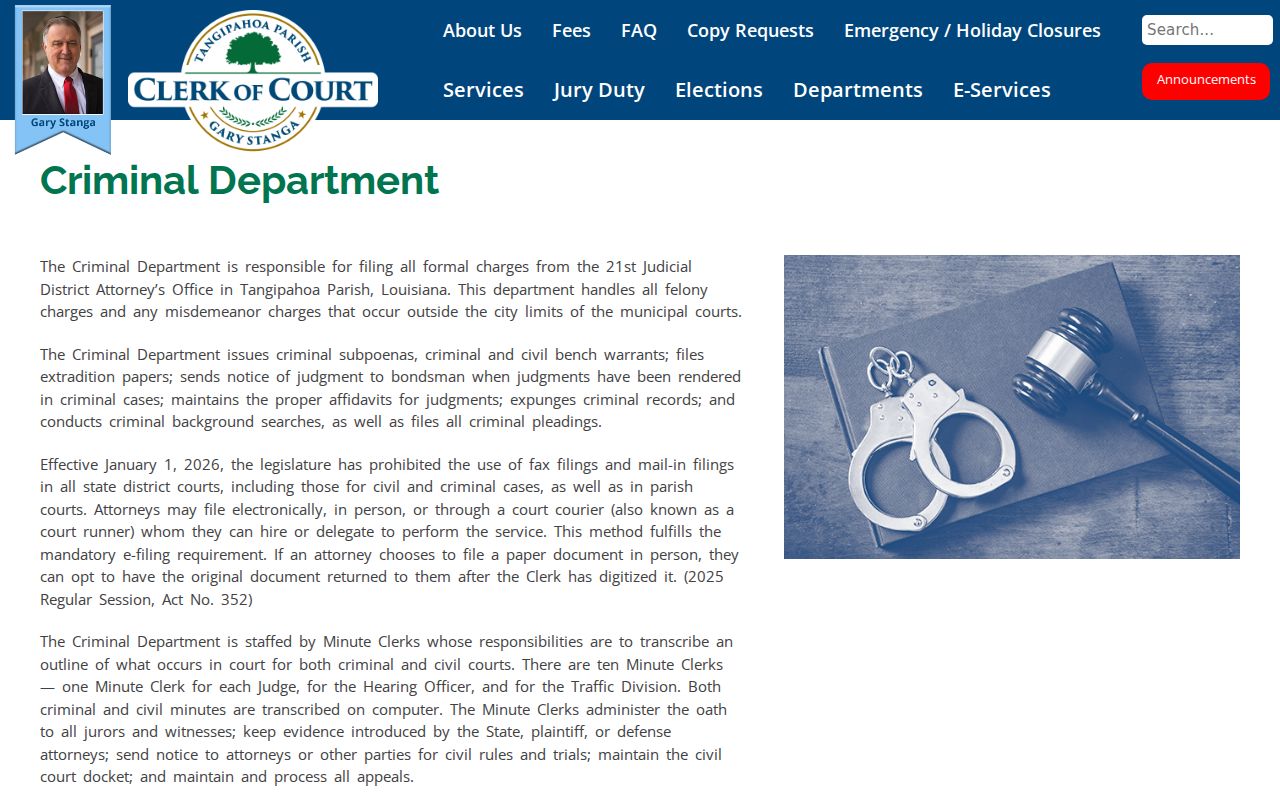
This source image ties the records counter to the office that maintains the parish's district criminal files.
Searching Tangipahoa Parish Case Records
The Clerk's Criminal Record eSearch is the remote channel. It uses a separate account and subscription. Published access costs are $20 for 24 hours, $40 for 30 days, and $300 for one year; printing costs $1 per page. Criminal index coverage reaches to 1901, but detail before the 1980s may be incomplete. Document images generally begin in January 2007, with older files added as scanning continues.
- Open Criminal Record eSearch and create the distinct login or subscription required for criminal records.
- Use the exact docket number when known. Otherwise, begin with the person's legal name.
- Compare the filing year, charge, division, and event dates to separate common-name results.
- Read the docket entries before opening images. Locate arraignment, motion, plea, judgment, and sentencing entries.
- Order the needed plain or certified document, or use the free onsite terminal before buying copies.
| Field Label | Type | Required | Notes |
|---|---|---|---|
| Party name | Text | Not confirmed | Use the full legal name; exact vendor labels are login-gated. |
| Case number | Text | Not confirmed | The strongest identifier when copied from a notice or pleading. |
| Filing year | Date/year | Not confirmed | Helps distinguish people with the same name. |
| Charge or case type | Filter | Not confirmed | Confirm the filed charge rather than relying on the booking allegation. |
| Division or status | Filter | Not confirmed | Useful for matching the case header and current posture. |
Tangipahoa Parish Court Search Costs
Remote access, a staff search, and a certified copy are separate products. The Clerk's official FAQ lists $1 per page, $3 extra for a conformed copy, and $5 extra for a certified copy. The online service advertises $10 per certified document plus $1 per page. Ask for a quote because the staff and online channels use different published amounts.
The same FAQ distinguishes a $20 name search from a $10 disposition and a $10 minute extract. A person who only needs the final result may not need every pleading. A criminal transcript is different again: it requires a written order signed by a judge. Judge availability can affect that request.
The Clerk FAQ source is the best place to check the current service definitions.
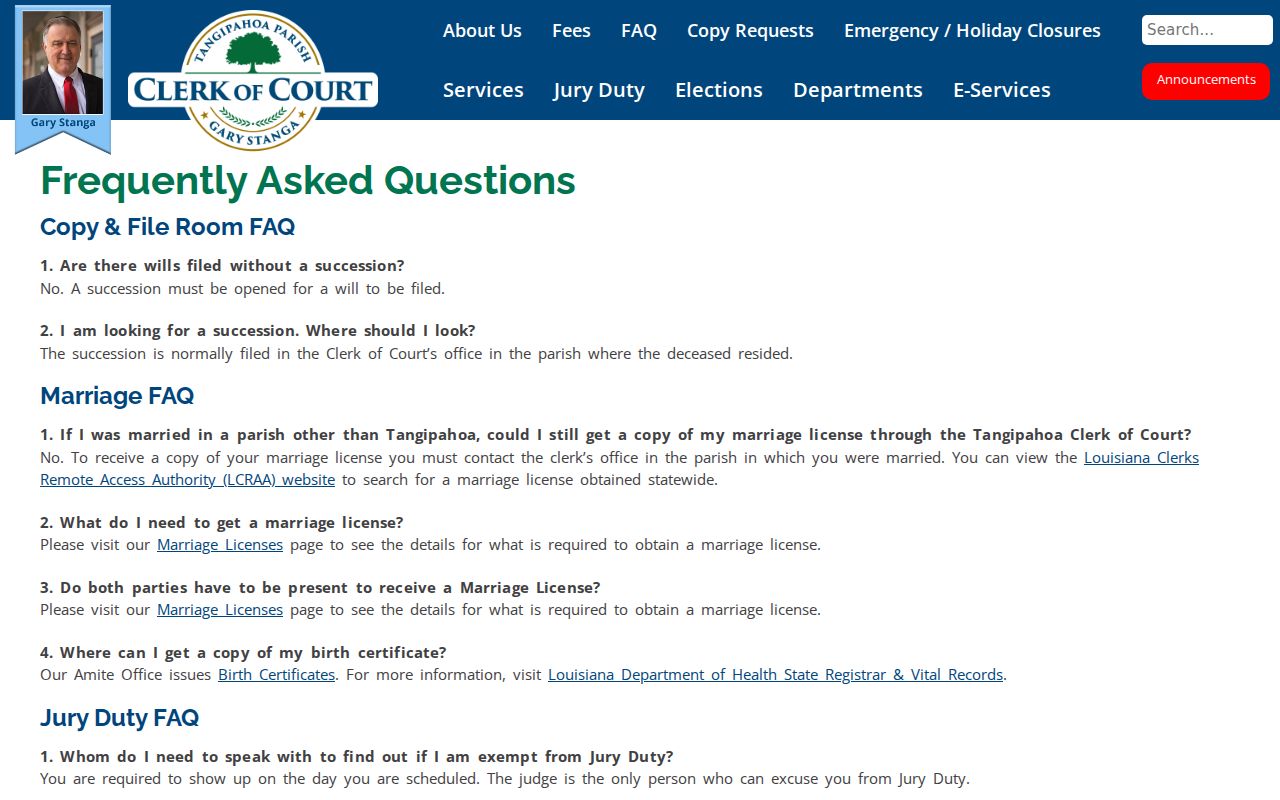
The image supports the distinction between searching a name, buying a disposition, and ordering copies from the file.
Inside a Tangipahoa Parish Case File
A Tangipahoa Parish criminal case file tracks prosecution and adjudication. Its header can show the docket number, caption, division, filing date, and status. Event entries may include allotment, arraignment, motions, hearing settings, minutes, plea or trial, judgment, sentence, a capias, probation, and satisfaction. A capias is a court writ directing custody, often after failure to appear or comply.
| Case Number & Court | Identifies the docket, assigned division, filing date, caption, and court. |
|---|---|
| Charging Document | Shows an indictment, bill of information, or complaint and the filed counts. |
| Docket Entries | Chronological filings, minutes, settings, motions, pleas, and later orders. |
| Hearing Dates | Dates set by the court; verify current dates through the proper court channel. |
| Disposition & Judgment | Shows dismissal, nolle prosequi, acquittal, guilty plea, conviction, or other outcome. |
| Sentence & Conditions | May state confinement, suspended time, probation, fines, costs, and restitution. |
Tangipahoa Parish Criminal Transcripts
A docket entry or minute is not a word-for-word transcript. The 21st JDC transcript request channel explains the court-reporter path, while the Clerk states that a criminal transcript needs a written judicial order. The judge, not the general records desk, controls that authorization.
Start by identifying the case number, division, hearing date, and proceeding. Ask whether a minute entry, judgment, or disposition will meet the need before seeking a full transcript. Those shorter records often state the official outcome and cost less to obtain. If a transcript is required, allow time for the order and court-reporter estimate.
The court's transcript source identifies the correct request path.
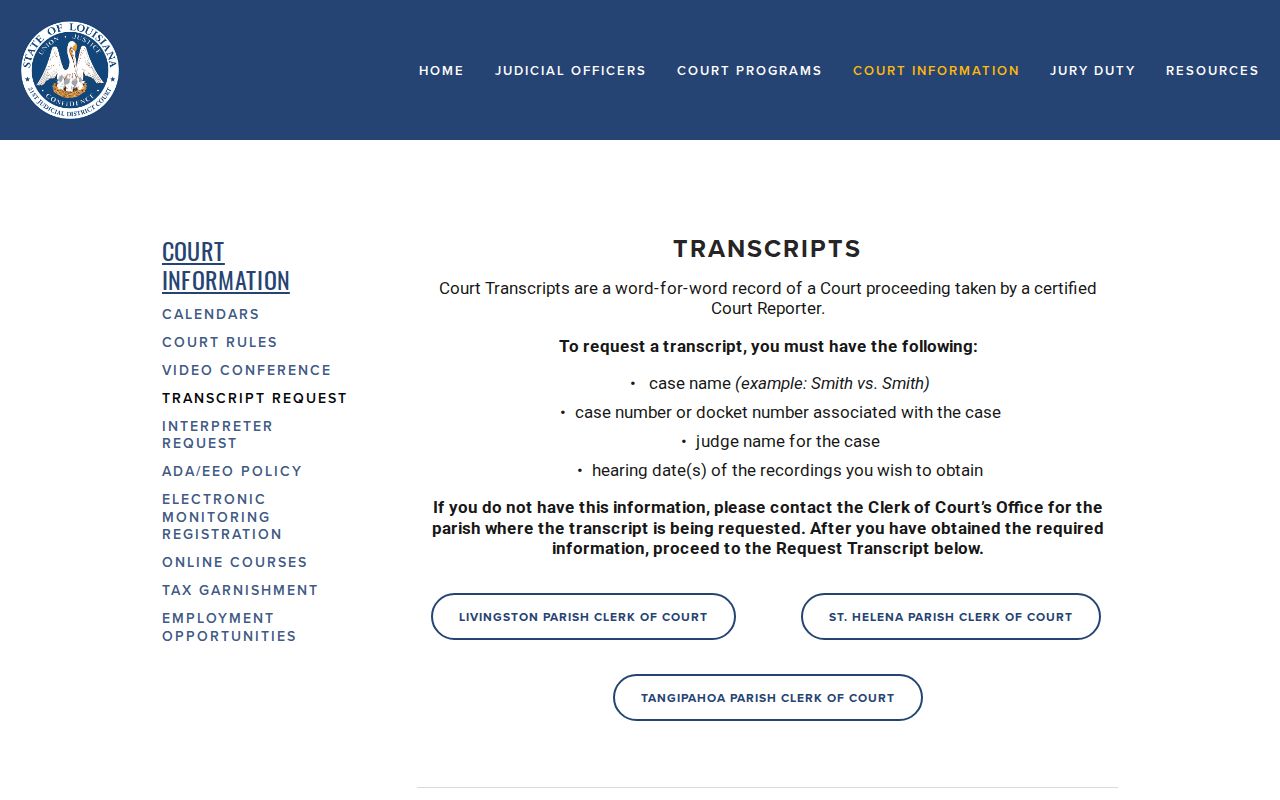
This court image reinforces why transcript production follows a different route from an ordinary Clerk copy request.
How a Criminal Case Moves
After an arrest and initial appearance, the prosecutor screens the referral. A felony may proceed through a bill of information or grand-jury indictment. Arraignment records the plea. Discovery, motions, and hearing settings follow. The matter may end through a plea, trial, dismissal, nolle prosequi, or acquittal, with judgment and sentence entered when guilt is found.
Case flow: Charges Filed › Arraignment › Pretrial › Plea or Trial › Disposition › Sentencing
Post-conviction filings and appeals can add later entries. No standard duration was confirmed for Tangipahoa Parish, so a filing date should not be used to predict when the case will end. Verify a current hearing through the District Attorney or court rather than relying on an old docket printout.
Reading Tangipahoa Parish Dispositions
The final line matters more than the first charge. “Nolle prosequi” means the prosecutor chose not to proceed with that charge. A dismissal ends the charge without a conviction. An acquittal is a not-guilty finding. A conviction is a judgment of guilt after a plea or trial. These results should not be merged into one broad label.
- Nolle prosequi
- The prosecutor declines to continue the charge.
- Disposition
- The final or current result of a charge.
- Minute entry
- The court's concise record of what occurred at a hearing.
- Capias
- A court writ directing that a person be taken into custody.
A booking record may keep the allegation that existed at intake even after the court changes or dismisses it. Compare the docket's judgment or final minute with the separate Tangipahoa Parish arrest lookup when tracing the same event. The court file controls what happened in prosecution.
Case Record Access & Restrictions
The Louisiana Public Records Law provides the general custodian framework, but public status does not make every field visible. Social Security numbers, protected victim or minor information, sealed material, and some investigative or medical details may be removed. Grand-jury deliberations remain secret even when a returned indictment becomes part of the court case.
Louisiana expungement removes a qualifying record from public access without destroying it. Article 973 makes an expunged record confidential while preserving defined access for law enforcement, courts, and the subject. If a case does not appear online, ask the Clerk whether it is in an older paper index, has limited images, belongs to a city court, or is restricted. Absence from eSearch alone does not prove that no file exists.
The Louisiana Supreme Court supplies the state judicial context for local court administration.
This state-court source places the 21st JDC and its records within Louisiana's broader judicial branch.
Tangipahoa Parish Online Case Images
Index coverage and scanned-image coverage are not the same. Tangipahoa Parish criminal information reaches back to 1901, yet older entries may lack modern detail. Online document images generally start in January 2007. Back-scanning can add older pages, while some paper records still require staff help or an in-person visit.
The official eSearch source states the coverage and subscription terms.
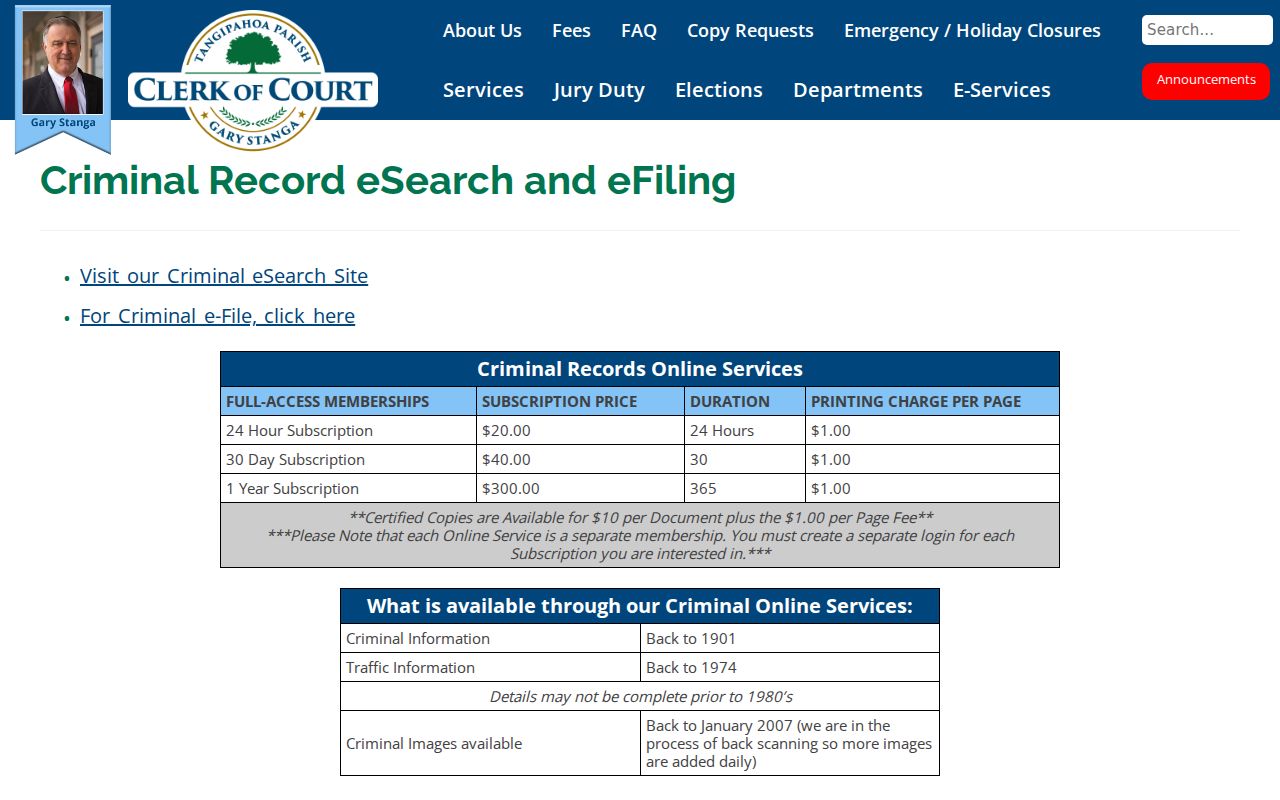
The portal image helps distinguish a searchable index entry from a scanned pleading or judgment available for purchase.
When older Tangipahoa Parish case detail is sparse, bring the known name, approximate filing year, charge, and any docket reference to the Criminal Department. Staff can explain which search product applies, but asking staff to verify online results is itself a paid criminal-history search. Starting on the free public computer can narrow the file before copies are ordered.
Note: A missing online image may still exist in the Clerk's paper file or back-scan queue.